An artist statement is a short piece of writing, usually 100 to 300 words, that explains what you make and why, in your own voice. It sits beside your work on a website, application or gallery wall and helps people understand it without you in the room.
Below you will find eight original artist statement examples for different mediums, a fill-in template, a step-by-step method and a checklist. The advice draws on the guide on writing an artist statement from The Creative Independent and The Art League’s post on artist statements, both read on 18 November 2026, and the examples were written for this guide by us. The artists in them are fictional, so use them to see the structure and then write your own.
What Is an Artist Statement?
The statement describes your work: the medium, the subject and the motivation behind it. It is not a biography and it is not a list of achievements. Many residencies, grants and exhibitions ask for one, and it also works well on a portfolio site or online shop, where visitors want to know who made the work and why.
It helps to separate it from the other documents artists write:
| Document | What it covers | Usual voice |
|---|---|---|
| Artist statement | What you make, why you make it and the ideas behind it | First person, in plain language |
| Artist bio | Who you are, where you studied or work, and what you have shown | Often third person |
| CV or résumé | A list of exhibitions, education, awards and experience | A structured list |
| Artwork caption | Title, year, medium and size of one piece | A short factual label |
What to Include in an Artist Statement
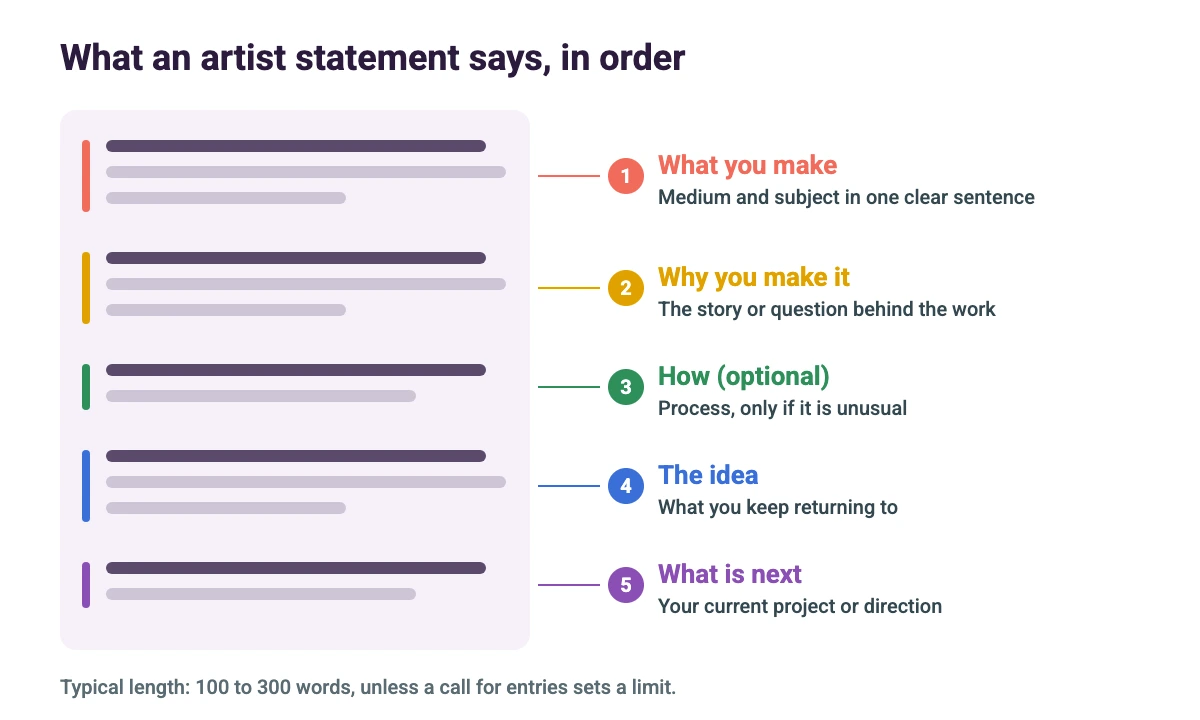
The Creative Independent says the basics are the medium, the motivation behind the work and, sometimes, the process, but only when the process is unusual or hard to see in the images. The Art League adds that a short statement with a hooking first line, some personality and a hint of why you make the work reads best. In practice that means:
- What you make. Name the medium and the subject in the first sentence.
- Why you make it. A personal reason, a question you keep asking or a moment that started the work.
- How you make it (optional). Include process only when it explains something the viewer cannot see.
- The idea you keep returning to. One theme, stated plainly, tied to your actual studio practice.
- What is next. A line about your current project gives the statement a sense of movement.
8 Artist Statement Examples
Each example follows the same simple structure, but the voice and details change with the medium. Notice how every statement names something concrete, such as a place, a material or a project.
1. Painter
I paint the stretch of coastline where I grew up, usually in the hour before a storm arrives. The light there turns flat and silver, and the water looks heavier than it does on a clear day. I work in oil on linen, building each sky from thin layers so the color seems to come from inside the canvas. I started painting these scenes after my family sold the house by the sea, and each canvas is a way of keeping that view in order. Right now I am working on twelve small panels that follow one beach across a single year.
Why it works: it opens with a specific place, names the medium, gives a personal reason and ends with the current project.
2. Photographer
I photograph strangers while they wait: at bus stops, in laundromats, outside clinics. People look different when they think nothing is happening, and I am interested in what their hands and shoulders say during that time. I shoot on a compact film camera with a single 35 mm lens and print the pictures small, so viewers have to step close. When someone asks about a photograph, I introduce myself and share a print. My current project follows one bus route from the first service of the morning to the last of the night.
Why it works: the subject is clear, the process detail (small prints) explains how the work is viewed, and the tone is calm and factual.
3. Digital Artist or Illustrator
I draw quiet scenes from invented worlds: a lighthouse keeper’s kitchen, a night market where nobody speaks. I work on a tablet, but I build each image from scanned paper textures so it keeps the feel of a printed book illustration. Color is my starting point. I choose a palette of five or six shades before I sketch anything, because limits force me to decide what matters in the picture. Each image leaves out the beginning and end of its story so the viewer can supply them. At the moment I am illustrating a picture book about a girl who repairs clocks.
Why it works: it explains a digital process in human terms and shows a clear working rule (the limited palette).
4. Ceramicist or Sculptor
I make functional stoneware: cups, bowls and teapots meant to be used every day. I throw on the wheel, leave fingerprints and trimming marks visible and finish each piece with a pale celadon glaze that pools in the grooves. I started making pots after a decade at a desk, and I still think of the wheel as a way to slow down. A good bowl should feel slightly different in the hand each time you pick it up. Everything is fired in a small electric kiln in my garage studio, in batches of about forty pieces.
Why it works: the objects and the way they are used are easy to picture, and the idea (slowing down) comes from lived experience.
5. Textile or Mixed Media Artist
My work is built from clothing that other people have thrown away. I cut worn denim, wedding linens and children’s coats into small shapes and stitch them back together into large wall pieces. Every seam is visible on purpose. The patches carry stains, repairs and name tags that I leave in place, so a viewer can read a history in the surface. I am interested in how long things stay useful and who decides when they are finished. I collect fabric from neighbors, and each piece lists where its materials came from.
Why it works: the materials are the story, and the closing detail (listing where the fabric came from) shows a consistent practice.
6. Printmaker
I carve linoleum blocks of the plants that grow in the cracks of my city’s pavement: dandelions, plantain, small ferns. Each print is pulled by hand on an old press, and I often use only two inks so the image stays simple and bold. Printmaking appeals to me because one block can make many copies, which suits subjects people usually walk past. My editions are small, between ten and twenty, and I number and sign every one.
Why it works: it links the medium (repeatable prints) to the subject (overlooked plants), which gives the process a reason.
7. Emerging Artist or Student
I make large charcoal drawings of my grandmother’s hands. I began the series when she could no longer garden, and I wanted a record of how she held things. Drawing slowly helps me notice details I would miss in a photograph, like the way her thumb curves when she pours tea. This series is the start of a larger project about family and work.
Why it works: early-career artists do not need a long list of credits. A clear subject, a personal reason and a direction are enough.
8. Short Statement for a Website or Social Profile
I make bold, hand-lettered posters for local shops and music nights. Every poster starts as a pencil sketch and ends as a layered screen print in three colors. I like work that people see on the street and remember by name.
Why it works: three sentences tell a visitor what you make, how it is made and what you care about, which is all a short profile needs.
Artist Statement Template
Copy this outline and fill in the brackets with specific details. Replace every general word with something only you could say.
- Opening: I make [medium] about [subject, place or question].
- Origin: I started this work when [a moment, change or question].
- Process (optional): I work with [materials or method], which [what that does to the work].
- Idea: Across the series I keep returning to [theme].
- Now: At the moment I am working on [current project or direction].
How to Write an Artist Statement in 6 Steps
- Collect rough notes first. The Art League suggests asking what keeps you in the studio, what people often ask about your work, what your artist story is and who your art is for.
- Write one clear opening sentence that names what you make or what it is about.
- Add the reason. Say what started the work or what question it keeps asking.
- Mention process only if it helps. If a viewer cannot tell how it was made, one sentence can explain it.
- Cut what does not belong. Remove résumé details, descriptions of how a picture looks and any theory you do not use in the studio.
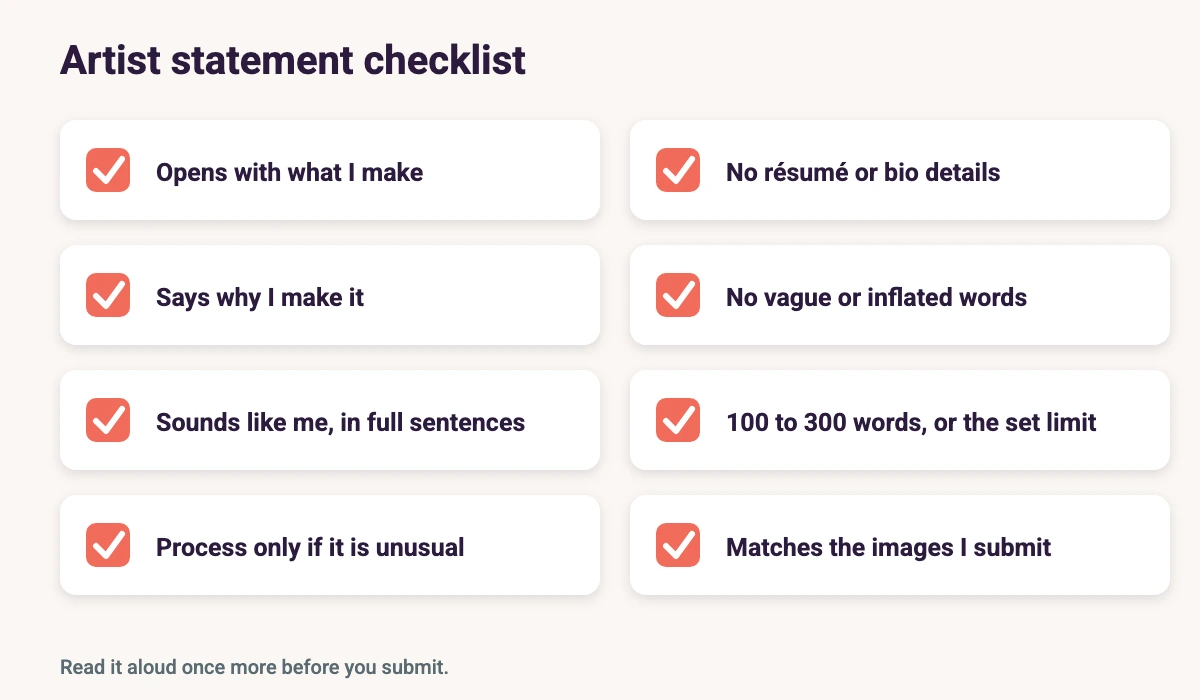
- Read it aloud and trim. Keep to the word limit if there is one, and check that it still matches the images you are submitting.
Make Vague Lines Specific
The Creative Independent warns against vague or inflated language, clichés and theory that is not tied to your work. Here are five common lines and how to make them concrete.
| Vague line | Specific rewrite |
|---|---|
| My art explores the human condition. | I paint my neighbors at their kitchen tables, because that is where people tell the truth. |
| I hope to evoke emotion in the viewer. | The paintings are dark at the edges, so you have to lean in to see the faces. |
| My work is inspired by nature. | I carve the weeds that grow through the sidewalk cracks near my studio. |
| I try to challenge ideas of beauty. | I photograph worn work gloves in soft window light, the way a studio would photograph jewelry. |
| My process is intuitive and always evolving. | I start each piece without a sketch and stop when I run out of the first color I mixed. |
Common Artist Statement Mistakes
- Repeating your résumé or bio. Keep exhibitions, awards and education for your CV.
- Describing what the work looks like. The viewer can already see it. Explain what they cannot see.
- Sounding generic. If a sentence could describe any artist, rewrite it with a detail only you know.
- Using inflated language. Words like “dialogue”, “liminal” and “interrogate” often hide the point. Plain words are clearer.
- Writing “hope” and “try”. The Creative Independent suggests saying what the work does instead.
- Letting it go out of date. A statement should match the images you submit with it.
Where to Use Your Artist Statement
| Where | What to focus on |
|---|---|
| Grant, residency or exhibition application | Follow the word limit exactly and match the statement to the images you submit. |
| Gallery or exhibition wall | Keep it short and in plain language for visitors who are walking by. |
| Portfolio or website | Place it near the work and keep it consistent with your bio and the rest of the site. |
| Online shop | Connect your story to the products, so buyers see why each piece exists. |
| Social profile | One or two lines with your medium and subject. |
If you sell your work, our guides to the best places to sell art online and how to start an Etsy shop show where a statement fits on a shop page. Photographers can also read how to sell photos to stock websites.
Turn Your Statement Into a Brand Story
A good statement is also the base of how you present yourself everywhere else. The same ideas appear in a brand story, so our brand story examples and guide to brand descriptions are worth a look, and what is your niche can help you decide what to emphasize. To share your work, Instagram marketing strategy covers how to keep a consistent voice on social media.
You can also lay your statement out as a one-page PDF or portfolio page in Canva. Our Canva font pairings can help with the typography, how to create a lookbook in Canva works well for a portfolio, and a business card size guide helps if you want to print a card with your website.
Conclusion
A strong artist statement is short, specific and written in your own voice. Start with what you make, say why you make it, add process only when it helps, and finish with what you are working on now. Use the examples and template as scaffolding, then replace every general phrase with a detail that only you could write.
Frequently Asked Questions
An artist statement is a short piece of writing that explains what you make and why, in your own voice. It usually covers the medium, the subject and the motivation behind the work, and it often goes with applications for exhibitions, grants and residencies.
The Creative Independent puts a typical statement at 100 to 300 words. Shorter versions of one to three sentences work for social profiles and wall labels. If a call for entries sets a word limit, follow it exactly.
Include what you make, why you make it and, if it helps, how you make it. Add the main idea you keep returning to and, if you like, what you are working on now. Leave out the résumé details.
The Art League suggests first person because it tends to produce clearer writing, though it is not a strict rule. Check the instructions for each application, because some venues state a preference.
A statement explains the work and the thinking behind it. A bio describes the person, such as background, education and exhibitions, and is often written in the third person.
Avoid repeating your résumé, describing what the artwork looks like, vague or inflated language, clichés and theory that does not connect to your actual work. Also avoid a statement that no longer matches your portfolio.
You can use a writing tool to brainstorm questions or tighten sentences, but a statement written entirely by a tool tends to be generic, which is the main mistake guides warn about. Write your own rough draft first so the details and voice are yours.
Update it whenever your work or the images in your portfolio change. The Creative Independent advises keeping it current with the images you submit.