Brand strategy development is the work of deciding who your brand is for, what it stands for, how it is different and how it should sound and look, before you design a single logo or post. The result is a short written plan that anyone on your team, or any freelancer you hire, can follow.
A clear plan turns vague ideas like “we are friendly and professional” into choices you can act on. It also saves money later, because you stop redesigning things every time your opinions change. Mailchimp describes a brand strategy as the plan a company follows to hold a unique, recognizable position in its market, and HubSpot calls it a long-term plan for how a brand presents itself and builds lasting relationships with its audience.
This guide gives you a 7-step brand strategy development framework, a copy-and-paste template and a worked example for a fictional illustrator. It is written for small businesses, freelancers and designers who are doing this themselves, though the same steps work for a bigger team.
What Is Brand Strategy Development?
Brand strategy development is the process of defining your audience, purpose, positioning, voice and messaging, then turning those decisions into a plan you review over time. Think of it as the thinking that sits underneath everything people see.
People often mix up brand strategy, branding and marketing strategy. They are related, but each answers a different question. For a deeper look at the visual side, our guide to branding vs brand identity explains where identity fits.
| Question | Brand strategy | Branding and brand identity | Marketing strategy |
|---|---|---|---|
| Main question | Who are we for, and what do we stand for? | How do we look and sound? | How do we reach and win customers right now? |
| What it produces | Audience, purpose, positioning, voice and messaging | Logo, colors, fonts, image style and brand guidelines | Channels, campaigns, budget and content calendar |
| Example output | A positioning statement | A brand kit | A three-month campaign plan |
| How often it changes | Rarely, reviewed about once a year | Occasionally, when the brand evolves | Often, by campaign or season |
The 7 Steps of Brand Strategy Development at a Glance
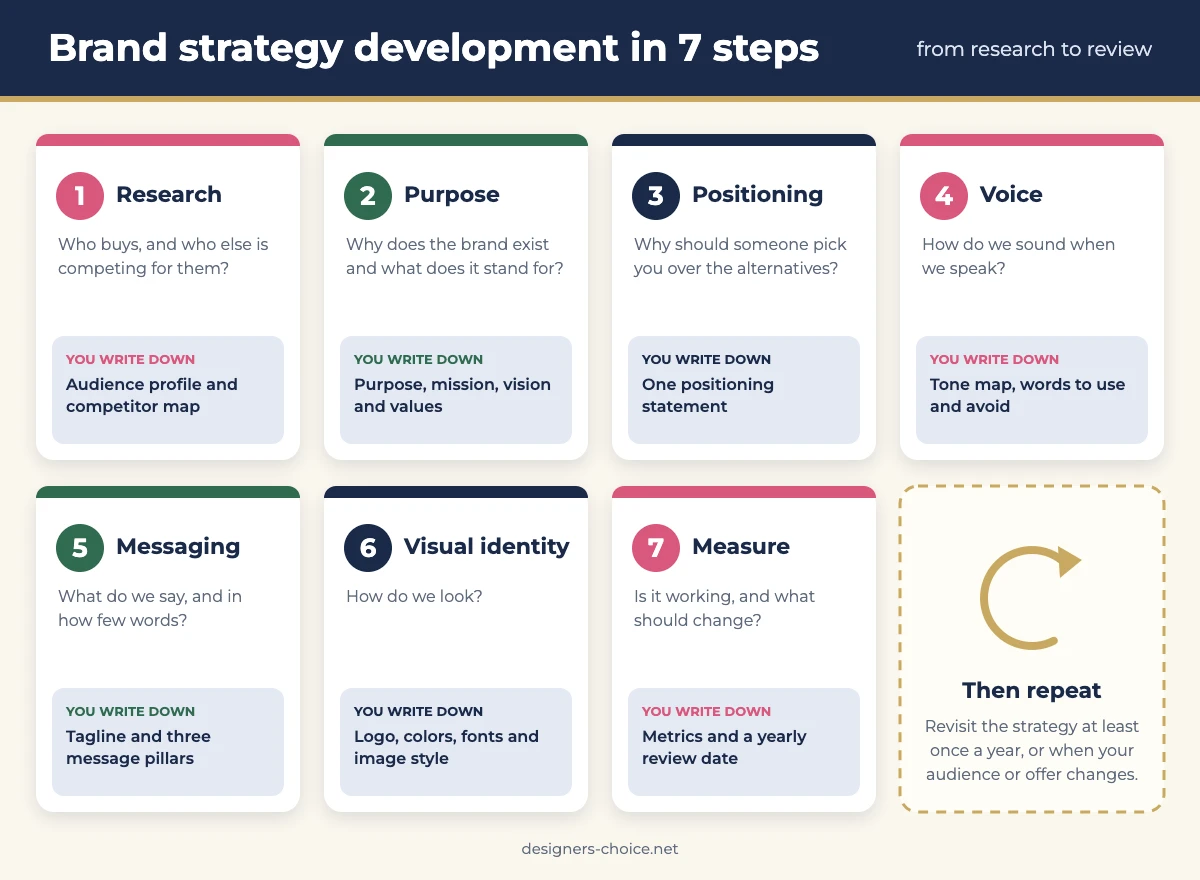
Here is the whole framework on one page. Each step has a question to answer and something to write down, so you finish with a document instead of a feeling.
| Step | Question to answer | What you write down |
|---|---|---|
| 1. Research | Who buys, and who else are they considering? | Audience profile and competitor map |
| 2. Purpose | Why does the brand exist and what does it stand for? | Purpose, mission, vision and values |
| 3. Positioning | Why should someone choose you over the alternatives? | One positioning statement |
| 4. Voice | How do we sound when we speak? | Tone map, words to use and words to avoid |
| 5. Messaging | What do we say, and in how few words? | Description, tagline and three message pillars |
| 6. Visual identity | How do we look? | Logo, colors, fonts, image style and guidelines |
| 7. Measure | Is it working, and what should change? | Metrics and a yearly review date |
How to Develop a Brand Strategy, Step by Step
Step 1: Research Your Audience and Competitors
Start with facts, not opinions. A strategy built on guesses tends to describe the brand you wish you had, not the one people will actually buy from.
Mailchimp suggests building a handful of buyer personas, and if you have no customers yet, working from market research and educated guesses about likely buyers. Either way, cover these three areas:
- Audience: who buys (or will buy), what problem they are trying to solve, what they use today and what frustrates them about it.
- Competitors: three to five alternatives, including indirect ones, such as a template marketplace if you are a custom designer. Note what each promises, how it looks and where it falls short.
- Evidence: talk to at least five real customers or prospects, read reviews of your competitors and look at the questions people ask on social media and in search.
Output: a one-page audience profile and a short competitor map. Look for the gap: something your audience wants that the alternatives do poorly.
Step 2: Define Your Purpose, Mission, Vision and Values
These four statements are easy to confuse, so keep each one short and different from the others.
- Purpose: why the brand exists beyond making money.
- Mission: what you do, for whom and how.
- Vision: what you want to be true in the future.
- Values: three to five words that guide decisions, such as craft, honesty or speed.
A good test for a value: can you name a time it made you say no to something? If not, it is a slogan, not a value. If sustainability is one of yours, our guide to sustainable branding shows how to back it up with real actions instead of claims.
Output: one sentence each for purpose, mission and vision, plus your short list of values.
Step 3: Write Your Positioning Statement
Positioning is the spot you want to own in your audience’s mind compared with the alternatives. A positioning statement makes you say it in one sentence. A common fill-in format looks like this:
For [target audience] who [need or problem], [brand] is a [category] that [main benefit], unlike [main alternative], which [weakness of the alternative].Each blank is a decision. If you cannot fill in the “unlike” part, you have not done enough competitor research. Mailchimp also recommends writing a positioning statement for each persona if you serve more than one audience.
Keep this statement internal. It is for your team and your designers, not for your website. Your public tagline comes later, in step 5.
Output: one positioning statement that a competitor could not honestly copy.
Step 4: Choose Your Brand Voice
Brand voice is your personality in words, and tone is how that voice adjusts from one situation to another. Nielsen Norman Group describes four dimensions of tone of voice that work like sliders: formal to casual, serious to funny, respectful to irreverent, and matter-of-fact to enthusiastic.
Place your brand on each slider, then add a few exact words you use and a few you avoid. NN/g also advises keeping the brand personality steady while letting tone shift with the topic and the reader’s mood, so a refund email can sound calmer than a launch announcement.
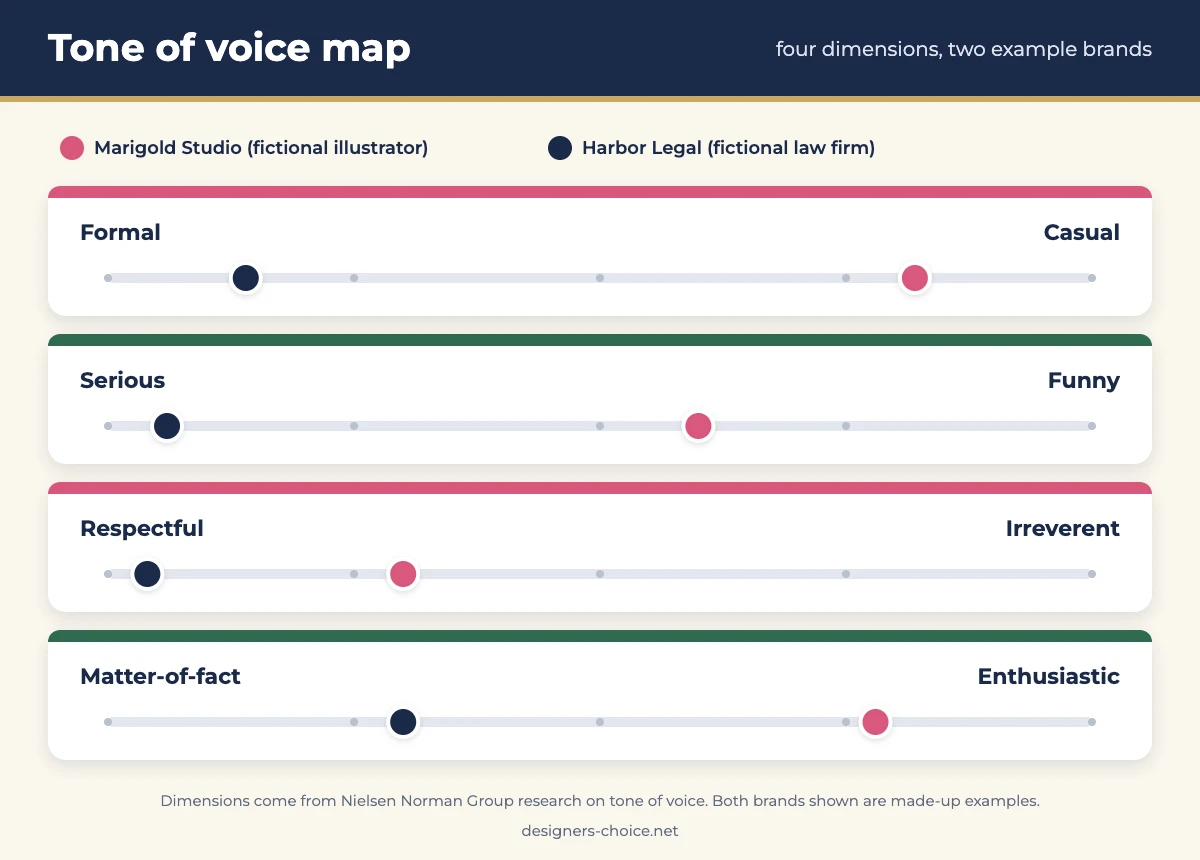
In the map above, the fictional illustrator sits on the casual, warm side, while the fictional law firm stays formal and serious. Neither is better. Each fits its audience.
Output: a tone map, three words you use (for example “warm”, “clear”, “handmade”) and three you avoid (for example “cheap”, “hustle”, “synergy”).
Step 5: Build Your Messaging
Messaging turns your strategy into words you can reuse everywhere. You need only three things to start:
- A one-sentence description: what you do and for whom, with no jargon. Our guide to brand descriptions has formulas you can borrow.
- A tagline: a short line that captures the main benefit or feeling. It can change over time. Your positioning statement should change far less often.
- Three message pillars: the three ideas you want people to link with you, each backed by a proof point such as a number, a process or a customer result.
If your brand has an origin story, this is the place to shape it. Our brand story examples show structures that work.
Output: a description, a tagline and three message pillars with proof points.
Step 6: Design Your Visual Identity and Guidelines
Only now do you open a design tool. Because the thinking is done, design choices become easier to defend: a color is warm because the voice is warm, not because it was trending.
- Logo: a primary version, a small version for profile pictures and clear-space rules. For quick options, see our roundup of the best AI tools for logo design, and judge every result against your positioning statement.
- Colors: a main color, one or two supporting colors and neutrals, with the HEX codes written down.
- Fonts: one heading font and one body font are enough to start. Our Canva font pairings guide has combinations you can test.
- Image style: photography, illustration or icons, and the rules for each, such as lighting, crops or line weight.
Write all of this into a brand kit or style guide so anyone can apply it. Our guides to brand kit examples and brand guidelines examples show what to include and how large companies document it. Once the kit exists, apply it to everyday pieces such as your own business cards.
Output: a brand kit with your logo files, colors, fonts and image rules.
Step 7: Launch, Measure and Review
Roll the strategy out the same way everywhere: your website, social profiles, email signature, proposals and packaging. Mailchimp ends its process with an evaluate-and-update step, measuring awareness, return on investment and audience engagement, then revising as the brand changes. If you coach or consult, a free resource that grows your email list can be one of the first things you roll out, and our guide to lead magnet ideas for coaches shows 12 formats.
Pick three to five numbers and check them on a schedule. The measurement table below lists options that do not need expensive tools. If Instagram is one of your main channels, our Instagram marketing strategy guide covers how to plan content around it.
Output: your chosen metrics and a review date in the calendar.
Brand Strategy Template (Copy and Paste)
Copy this one-pager into a document and fill in each line. Keep it to a single page. If it is longer, people will not read it.
BRAND STRATEGY ONE-PAGER

1. AUDIENCE
Who we serve:
Their main problem:
What they use today:
Our three closest alternatives:

2. PURPOSE
Purpose (why we exist):
Mission (what we do, for whom):
Vision (where we are heading):
Values (3 to 5 words):

3. POSITIONING
For [audience] who [need], [brand] is a [category] that [main benefit], unlike [alternative], which [weakness].

4. VOICE
Formal 1 2 3 4 5 Casual:
Serious 1 2 3 4 5 Funny:
Respectful 1 2 3 4 5 Irreverent:
Matter-of-fact 1 2 3 4 5 Enthusiastic:
Three words we use:
Three words we avoid:

5. MESSAGING
One-sentence description:
Tagline:
Message pillars (3):

6. VISUAL IDENTITY
Logo rules:
Colors (HEX):
Fonts:
Image style:

7. PLAN
Channels:
Metrics (3 to 5):
Review date:
Worked Example: Marigold Studio (Fictional)
To show how the template looks when it is filled in, here is a made-up example. Marigold Studio is a fictional freelance illustrator who makes hand-drawn wedding stationery on recycled paper. Everything below is invented for illustration.
| Section | Marigold Studio example |
|---|---|
| Audience | Couples planning small weddings who want invitations that feel personal and low-waste |
| Competitors | Template marketplaces (fast but generic) and local print shops (limited design choice) |
| Purpose and mission | Purpose: make wedding paper people keep. Mission: create hand-illustrated stationery on recycled paper for couples who want something personal. |
| Values | Craft, warmth and honesty about materials |
| Positioning statement | For couples planning small weddings who want invitations that feel personal, Marigold Studio is a hand-illustrated stationery studio that offers custom artwork on recycled paper, unlike template marketplaces, where the same design appears on hundreds of invitations. |
| Voice | Casual, a little funny, respectful and enthusiastic (see the tone map above). Uses “keepsake”, “hand-drawn” and “yours”. Avoids “cheap”, “bulk” and “hustle”. |
| Messaging | Tagline: “Paper worth keeping.” Pillars: made by hand, made to keep, made with less waste. |
| Visual identity | Marigold yellow, deep green and cream. A serif for headings and a clean sans-serif for body text. Botanical line illustrations. |
| Plan and metrics | Portfolio site and Pinterest. Track inquiries per month, searches for the studio name and the share of clients who come from referrals. |
How to Measure Whether Your Brand Strategy Is Working
Brand effects build slowly, so look at trends over months, not days. Choose a few signals that match your goals and record them in the same place each month.
| What to track | What it tells you | Where to find it |
|---|---|---|
| Branded searches | How many people look for your name directly | Google Search Console, filtering queries that contain your brand name |
| Direct traffic and referrals | Whether people remember your site or get sent to it | Your website analytics tool |
| Social follows, saves and shares | Whether your content and voice resonate | Analytics inside each platform |
| Email list growth | Whether people choose to hear more from you | Your email tool |
| Customer feedback | Whether people describe you the way you intend | A short survey asking them to describe you in three words |
| Repeat customers and referrals | Loyalty and trust | Your sales or booking records |
Compare the numbers with the goals in your plan. If they move the wrong way, review the strategy before you change the logo.
Common Brand Strategy Mistakes and How to Fix Them
| Mistake | Why it hurts | Fix |
|---|---|---|
| Skipping research | The strategy describes the brand you want, not what buyers need | Talk to real customers before you write a word |
| Trying to appeal to everyone | Messages become vague and forgettable | Choose one primary audience and write for them first |
| Copying a competitor | You become a weaker version of the original | Fill in the “unlike” blank of your positioning statement honestly |
| Starting with the logo | Design has no direction, so it gets redone | Finish steps 1 to 5 first |
| Leaving the document in a drawer | People make off-strategy choices without noticing | Keep it to one page, share it and link it from your brand kit |
| Changing it too often | Audiences never learn what you stand for | Review yearly and change positioning only when your audience or offer changes |
Conclusion
Brand strategy development does not need a big budget. It needs honest answers to a short list of questions, written down in one place. Start with the template above, fill in the first three sections this week and share the page with anyone who designs or writes for you.
Then build your visuals and messaging on top of it. Your logo, colors and posts get easier to choose because they all trace back to the same decisions. Put a review date in your calendar so the strategy keeps up with your business.
On LinkedIn, your banner is one of the first places to show it, so see our guide to the LinkedIn banner size.
Frequently Asked Questions
Brand strategy development is the process of defining who your brand serves, what it stands for, how it is different and how it should sound and look. The outcome is a written plan, usually one to a few pages, that guides your design, messaging and marketing decisions.
A practical order is: research your audience and competitors, define your purpose and values, write a positioning statement, choose your voice, build your messaging, design your visual identity, then launch, measure and review. The framework above walks through each step with a template.
Brand strategy decides who you are for and what you stand for. Branding is how that shows up in your logo, colors, fonts, imagery and tone. Strategy comes first, so the visuals have a reason to look the way they do.
It depends on the size of the business and how much research you already have. A solo freelancer can draft a first version of the one-pager in a few days. Larger companies with many stakeholders usually take longer. Treat the first version as a working draft and revise it as you learn.
Yes. The template and steps in this guide are built for do-it-yourself use. An outside strategist can help when you want an unbiased view, serve several audiences or are repositioning a larger brand, but a clear one-pager written by the owner is a strong start.
Costs vary widely. Doing it yourself costs time and perhaps a few customer interviews. Agencies and consultants price by scope, so ask for a written list of deliverables, such as audience research, positioning, messaging and guidelines, before you compare quotes.
A positioning statement is one internal sentence that says who your brand is for, the need it meets, its category, its main benefit and how it differs from the alternatives. Use the fill-in format in step 3, then test it by asking whether a competitor could honestly say the same sentence.
Track a few signals over months: branded searches, direct traffic, email list growth, repeat customers and the words customers use to describe you. If those trend up and customers describe you the way you intended, the strategy is doing its job.