AI generated images for commercial use raise two separate questions: does the tool let you use the picture in paid work, and can you own it. This guide sorts out what the tools and the U.S. Copyright Office say, so you can ask better questions before you deliver client work.
We are not lawyers, and this is general information, not legal advice. We read terms and help pages from Midjourney, Recraft, Adobe and Figma, plus the U.S. Copyright Office announcement of its copyrightability report. Where a page gives no answer, we write “Not stated.”
Illustration by Designers Choice, not an official screenshot
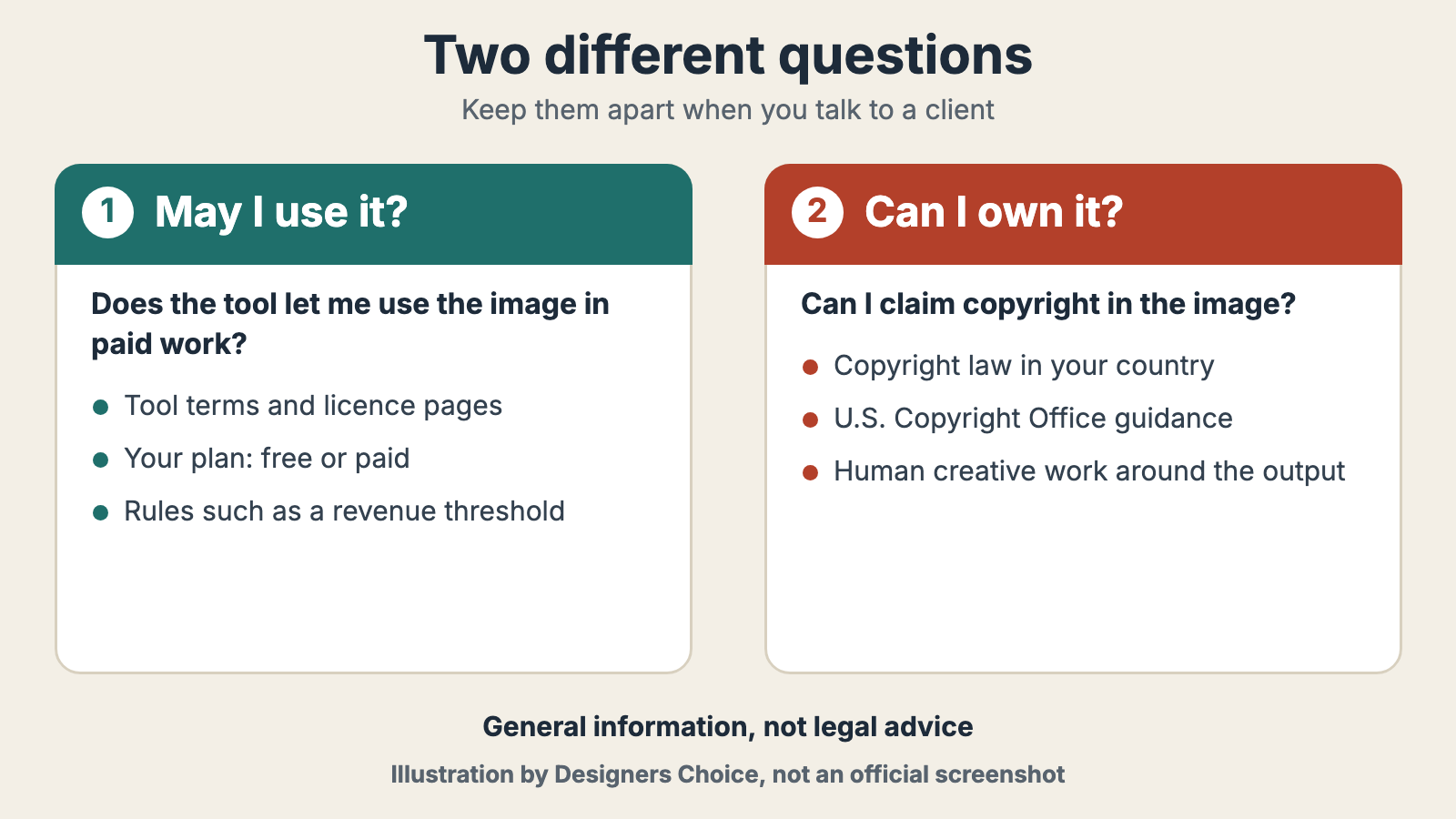
Two Questions, Not One
| Question | Where the answer lives |
|---|---|
| May I use this image in paid work? | The tool’s own terms, plan rules and licence pages |
| Can I claim copyright in it? | Copyright law in your country. In the U.S., the Copyright Office guidance |
People mix these up. A tool can let you use an image commercially and still leave you without copyright in it. The reverse can also happen. Keep the two questions apart when you talk to a client.
What the Tools Say About Commercial Use
| Tool | What its pages say | What is not stated on those pages |
|---|---|---|
| Midjourney | All plans fall under General Commercial Terms. Companies with more than $1,000,000 in gross revenue a year must buy Pro or Mega | Copyright ownership of images |
| Recraft | Paid plans make images private, and you own images you generate while on a paid plan, with full commercial rights. Free plan images are public and Recraft owns them, with commercial ownership rights not included | Whether one page’s wording about rights while subscribed matches the ownership page. Read both |
| Adobe Firefly | Adobe calls Firefly models safe for commercial use and says it trains only on content it has permission or rights to use. It does not train Firefly on customer content or content mined from the web | Which plans get IP indemnification. Adobe’s product page points to a qualifying SKU or plan and does not name it |
| Figma Make | Figma says Make may bring in third-party content such as fonts, code packages or images. You must make sure you have the rights before you publish | Licence terms for each item Make adds |
| Canva AI 2.0 | The Help Center pages we read cover features and allowances | Commercial use terms. Not stated on those pages |
For plan details on these tools, read our guides to Midjourney V8, Recraft AI and Adobe Firefly new features.
Adobe Firefly and IP Indemnification
Adobe’s Firefly product description, which Adobe published in August 2026, describes an IP indemnity. It applies if your agreement with Adobe links to that page. It covers listed Eligible Firefly Features, such as Text to Image, Generative Fill, Generative Expand, Text to Vector Graphic and Text to Video.
- Coverage depends on a qualifying SKU or plan, which the page does not name.
- The page excludes capabilities that Adobe marks as powered by non-Adobe models.
- Adobe says outputs may not be unique, and other users may generate the same or a similar result.
- Adobe says it automatically applies C2PA metadata when you download or export content that includes a Firefly asset.
Read your own agreement before you rely on indemnity. Our guide to Content Credentials explains the C2PA label.
What the U.S. Copyright Office Says
On January 29, 2025, the Copyright Office released Part 2 of its AI report, which covers copyrightability. It reached these main conclusions:
- Outputs of generative AI can be protected by copyright only where a human author has determined sufficient expressive elements.
- Protection can come from human-authored work that is perceptible in an AI output, or from human creative arrangements or modifications of the output.
- The mere provision of prompts does not give protection.
- Using AI to assist your creative process, or including AI material in a larger human-made work, does not bar copyright.
- The Office found that the case has not been made for changes to existing law to protect AI outputs.
This is guidance about U.S. copyright. It does not cover Europe or India. We did not research the rules in those regions for this guide, so ask a local lawyer if your client works there.
What This Means for Designers
This section is our own reading, not legal advice. If you only type a prompt and deliver the first result, the Office’s report suggests you may have little or no copyright in that image. If you combine, edit, arrange and redraw AI output inside your own layout, you have more to claim.
- Keep the layered source file. It shows your own creative work around the AI output.
- Save your prompts, settings and the plan you used when you generated each image.
- Do not assume two clients will get unique images. Adobe says outputs may not be unique.
- Check the tool’s plan before you deliver. A free plan may make images public, as Recraft says.
- Tell clients when a deliverable includes AI output.
- Consider adding Content Credentials to show your edits.
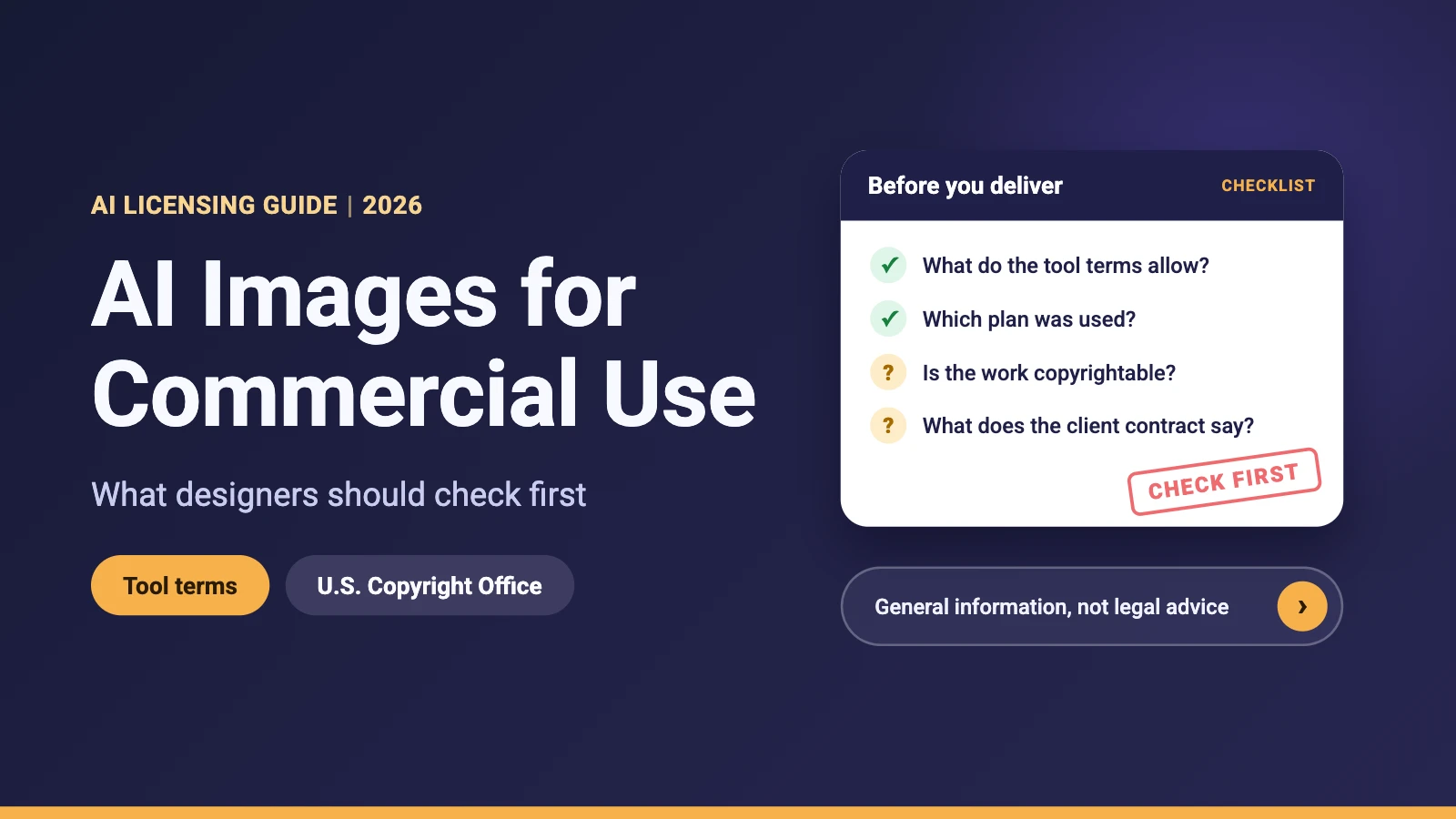
A Checklist Before You Deliver
- Read the tool’s terms on commercial use for your plan.
- Check whether your company size triggers a plan rule, as with Midjourney’s revenue threshold.
- Check who owns the image under the plan you used.
- Look for logos, brand names, real people or characters in the output and remove them.
- Keep records of your prompts, edits and plan.
- Ask a lawyer for contracts, high-value work and any country outside the U.S.
What We Did Not Cover
| Topic | Status in this guide |
|---|---|
| EU and Indian rules on AI images | Not researched |
| Copyright Office guidance on training data | Not covered. The Office listed it as a forthcoming part when it released Part 2 |
| Canva commercial use terms | Not stated on the pages we read |
| Court cases about AI images | Not covered |
For a broader tool list, see our roundup of the best free AI image generators.
FAQ
It depends on the tool and your plan. Midjourney says all plans fall under General Commercial Terms, and Recraft says paid plans include commercial rights while Free plan images do not. Check your own plan’s terms.
The U.S. Copyright Office says AI outputs can be protected only where a human author has determined sufficient expressive elements, and that prompts alone do not count. This is not legal advice.
The Copyright Office says human creative arrangements or modifications of an AI output can support protection. How much you must change is a legal question, so ask a lawyer for client work.
Adobe says Firefly models are safe for commercial use and trained on content it has rights to use. Adobe’s IP indemnity depends on a qualifying plan and agreement, which its page does not name.
It varies. Recraft says Free plan images are public and owned by Recraft, with commercial ownership rights not included. Check the free plan’s terms for each tool before you use any image in paid work.
The pages we read do not state a legal duty. We suggest you tell clients, because ownership and uniqueness may differ for AI output. Ask a lawyer about your contracts.
No. The Copyright Office guidance is for the U.S. We did not research rules in Europe or India for this guide, so check local law.
Keep your prompts, settings, the plan or licence you used, and your layered source files. Consider adding Content Credentials so your edits are recorded.